RAPP Website Redesign Audit
Evaluated RAPP's website to uncover UX opportunities and develop a strategy for a more engaging, user-centered digital experience.
Challenge:
RAPP's website no longer matched the agency's capabilities.
Solution:
Audited the experience and benchmarked competitors.
Impact:
Delivered a UX vision to guide RAPP's digital transformation.
Overview
As RAPP continued evolving as a global marketing and technology consultancy, its website no longer reflected the sophistication of its capabilities or the quality of its client work.
The site contained valuable content but lacked a cohesive user experience, modern storytelling, and clear pathways for prospective clients, talent, and partners.
I led a comprehensive UX audit and redesign strategy to identify opportunities for improving the site's usability, content organization, accessibility, and overall digital experience.
Rather than jumping directly into redesigning pages, I began by understanding how RAPP compared against industry leaders and where opportunities existed to create a more compelling digital experience.
The website served multiple audiences with very different goals:
Prospective clients
Prospective employees
Journalists
Consultants
Each audience required different information, yet the existing experience treated them similarly.
Additional challenges included:
Text-heavy pages
Limited visual storytelling
Inconsistent navigation
Weak differentiation from competitors
Accessibility improvements
Opportunities to strengthen SEO
Underutilized case studies
The Process
To ensure the redesign addressed the needs of every audience, I began by creating personas for RAPP's four primary user groups. This helped identify who they are, what motivates them, the challenges they face, what they hope to accomplish on RAPP.com, and the features and content most valuable to each audience.
Building on the audience personas, I created ideal user flows for each audience segment to map how they should navigate RAPP.com based on their goals and motivations. These flows established a user-centered blueprint for the redesign, revealing opportunities to streamline navigation, improve content discoverability, and create more intuitive pathways to the information each audience valued most.
To establish a benchmark for a best-in-class digital experience, I evaluated RAPP alongside leading agencies and consulting firms. Our UX team first used AI to assess 12 competitors across key website experience dimensions, enabling us to quickly identify strengths, weaknesses, and emerging industry patterns.
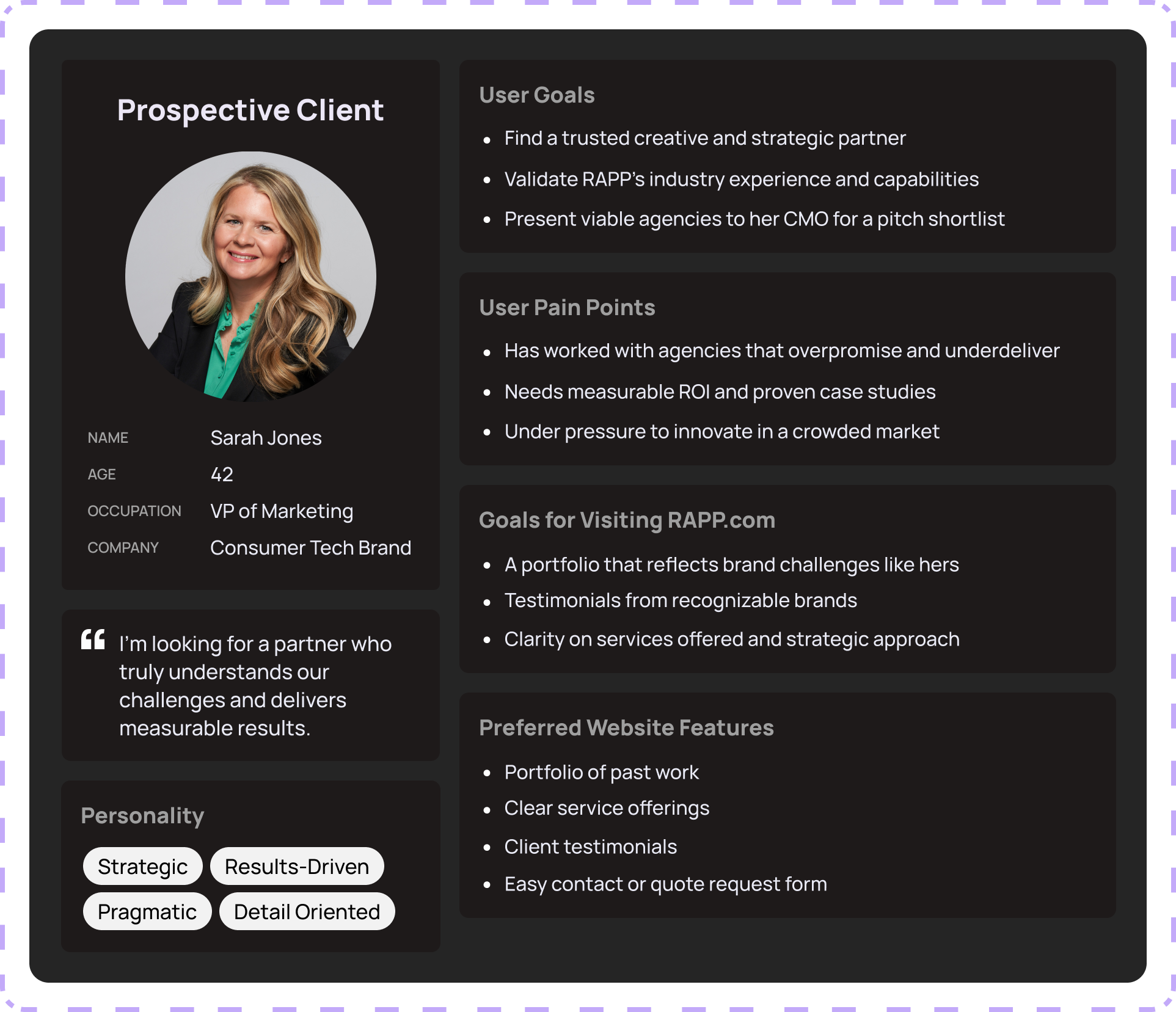
Example of an Prospective Client Persona
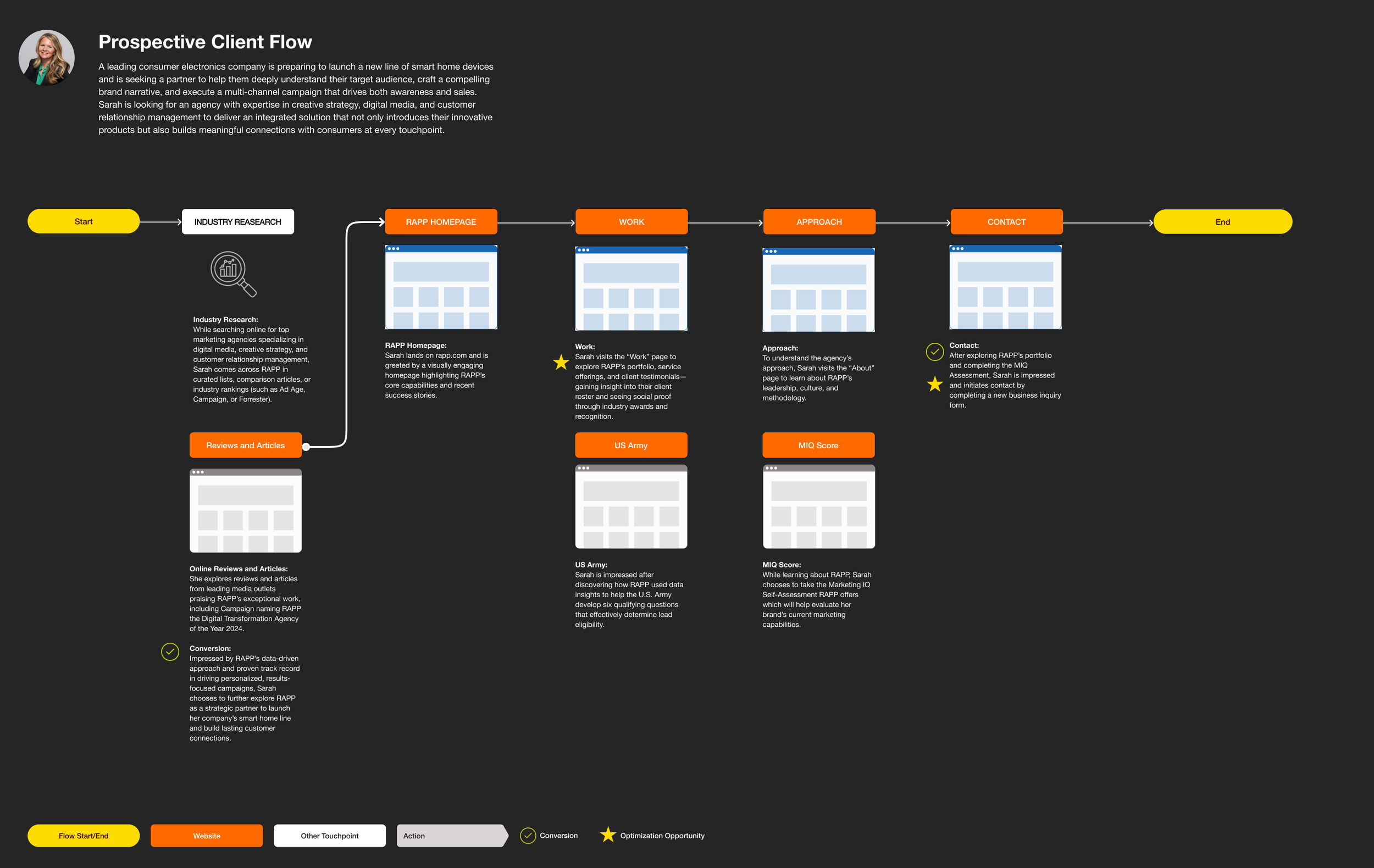
Example of an Prospective Client Ideal User Flow/Journey
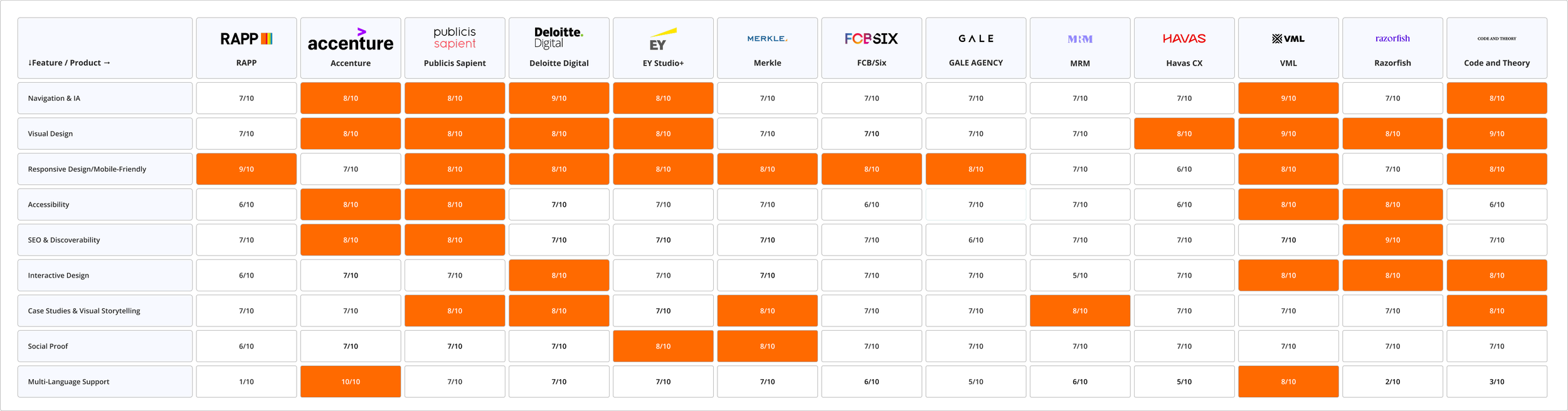
Overview of the competitive analysis
Key Insights
UX Discovery:
Build trust immediately through prominent social proof, client success stories, and awards.
Increase engagement with interactive experiences and stronger visual storytelling.
Modernize case studies to highlight business impact, process, and outcomes.
Improve usability with clearer navigation, accessible design, and localized content for global audiences.
Elevate RAPP's industry presence by expanding thought leadership and educational content.
Content Audit Key Insights:
Strengthen RAPP's value proposition. Clarify what differentiates RAPP from competitors through more distinctive messaging, stronger proof points, and a clearer brand narrative.
Showcase expertise through evidence. Expand case studies, client success stories, testimonials, and measurable outcomes to build credibility and demonstrate business impact.
Create content that engages and educates. Increase thought leadership, downloadable resources, and fresh insights to position RAPP as an industry leader and encourage repeat visits.
Guide users more effectively. Improve calls-to-action, navigation, and localized content so visitors can quickly find relevant information and confidently take the next step.
Humanize the brand. Introduce employee stories, culture content, and richer visual storytelling to create a more engaging experience and strengthen RAPP's personality.
To ensure the redesign aligned with both user needs and business objectives, I conducted stakeholder interviews with executive leaders across RAPP, including the CEO of RAPP North America, the SVP of Talent Acquisition, the CMO of the U.S., the CMO of the U.K., and other senior leaders. These conversations provided valuable insight into the company's vision, business priorities, and opportunities to strengthen RAPP's digital presence.
Key Stakeholder Insights
Clarify RAPP's value proposition. Executives consistently emphasized the need for the website to more clearly communicate what RAPP does, what differentiates the agency, and why clients should choose them.
Show proof over promises. Stakeholders wanted to feature more case studies, measurable business outcomes, client success stories, and employee perspectives to build credibility and trust.
Create a modern, engaging experience. Leaders agreed the website should better reflect RAPP's innovation through stronger visual storytelling, interactive experiences, motion, and video.
Simplify the user experience. Clearer messaging, intuitive navigation, and guided user journeys were identified as essential for helping visitors quickly find relevant content and take meaningful action.
Position RAPP as an industry leader. Stakeholders saw an opportunity to expand thought leadership, insights, and educational content to establish RAPP as a destination for innovation and marketing expertise.
Drawing on insights from user research, stakeholder interviews, and competitive analysis, I developed strategic recommendations to strengthen RAPP's value proposition, improve usability, and create a more engaging digital experience.
Final Recommendation
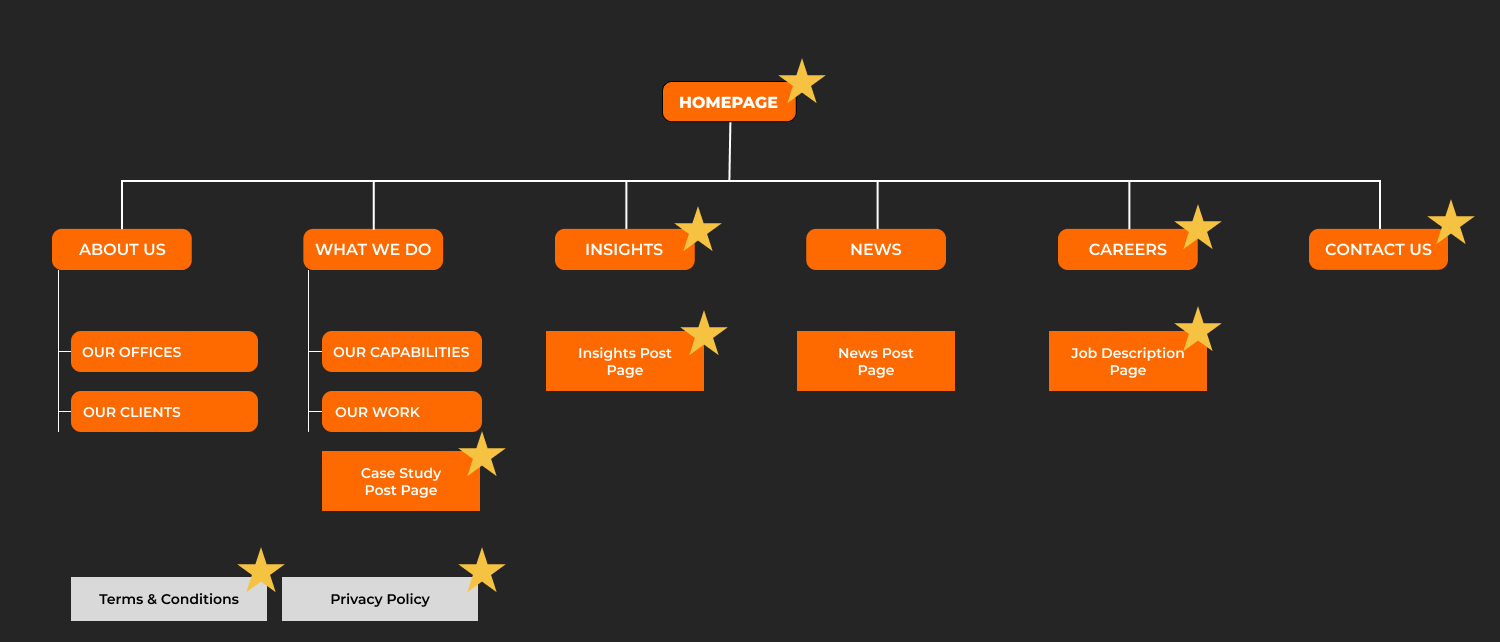
Suggested RAPP Redesign Site Map
Starred pages indicate pages prioritized for the MVP state.
The established UX strategy was to launch the redesigned website in two phases. An MVP to establish the new brand and support core marketing initiatives, followed by Phase 2 to deliver a fully optimized, best-in-class digital experience.