Army Hiring Manager Dashboard
Designed a hiring dashboard that made it easier for hiring managers to find, review, and manage candidates.
Overview
The U.S. Army Civilian hiring process involves reviewing large volumes of candidate information across multiple recruiting channels. Hiring managers needed a centralized platform to efficiently search, evaluate, and manage candidates without relying on fragmented systems or manual processes.
As the Senior UX Architect on the project, I designed an enterprise dashboard that streamlined the hiring workflow, making it easier for hiring managers to identify qualified candidates, manage recruiting activities, and make informed hiring decisions.
The result was a production-ready solution that was approved by the client and implemented as a live product.
The Challenge
Hiring managers were responsible for reviewing thousands of potential candidates while balancing recruiting events, interviews, document management, and communication with recruiters.
The existing process presented several challenges:
Candidate information was difficult to search and compare.
Recruiting activities were spread across multiple tools and spreadsheets.
Managers frequently repeated the same searches.
Event leads were difficult to capture and track.
Supporting documents were stored separately from candidate records.
The Army needed a modern enterprise experience that reduced administrative effort and enabled hiring managers to focus on selecting the right candidates.
Understanding the Problem Before Designing the Product
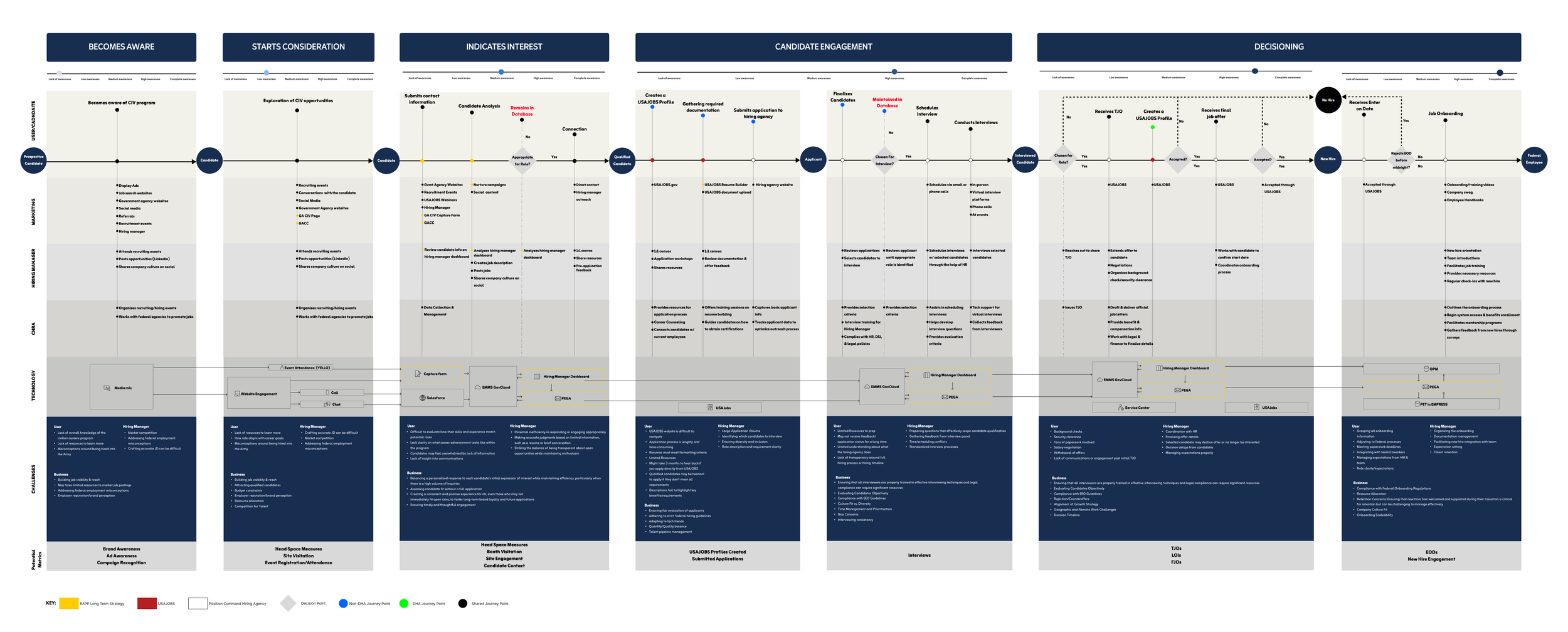
Before opening Figma, I wanted to understand the complete hiring experience—not just the hiring manager's portion of it.
I mapped the current-state Army Civilian recruiting journey from lead generation through hiring to identify how candidates progressed, where information changed hands, and which moments mattered most to hiring managers.
This systems-level view uncovered workflow inefficiencies, information gaps, and opportunities to streamline candidate management. Those insights directly informed the dashboard's navigation, user flows, and overall product architecture.
Key Insights
After mapping the recruiting ecosystem, several recurring themes emerged.
Hiring managers lacked a centralized workspace
Finding qualified candidates required repetitive searches
Important information was difficult to compare
Recruiting events created manual work
Information Architecture
I organized the dashboard around the tasks hiring managers perform most frequently.
The resulting navigation included:
Candidate Search
Saved Searches
Candidate Profile
Recruiting Events
Reports
Rather than organizing information by system, the dashboard was organized around user goals.
Key Features Implemented:
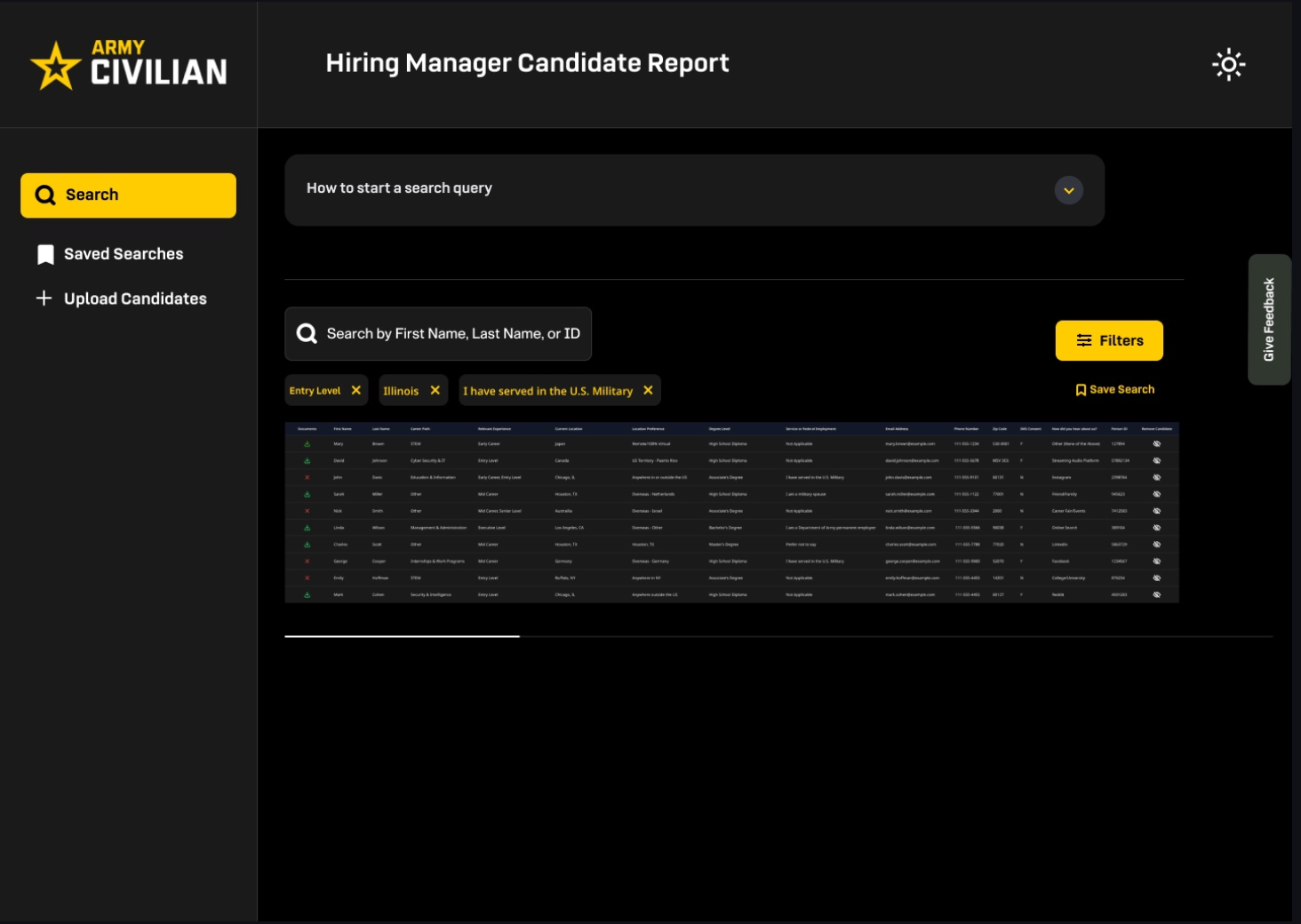
Run Search Queries: The dashboard enables hiring managers to search a candidate database by name or ID, and apply advanced filters to surface candidates that match specific criteria. For example, they can search for entry-level candidates based in Illinois with U.S. Military service experience, or candidates interested in Internships & Work Programs. Managers can view each candidate's full profile, download their resume and transcripts, and access contact details including email and phone number directly within the tool.
Save Search: To support recurring recruiting needs, the tool includes a Save Search feature that allows managers to bookmark frequently used query combinations and retrieve them quickly from a dedicated Saved Searches page eliminating the need to manually re-enter filter criteria for repeat use cases.
Upload Candidates: Hiring managers can upload candidates they meet at in-person recruiting and hiring events directly into the system, ensuring those leads are captured and tracked within the same platform.
Outcome:
The final design was approved by client stakeholders and progressed into development as a production-ready enterprise application.
The dashboard established a centralized experience that simplified candidate management, reduced repetitive recruiting tasks, and created a scalable foundation for future enhancements across the Army Civilian hiring platform.
