Army Lead Experience Audit
At a Glance
Challenge
No shared understanding of the recruiting experience.
Approach
Conducted immersive research and mapped the complete customer journey.
Solution
Created the first end-to-end recruiting journey map.
Impact
Adopted as the strategic foundation for onboarding, campaign planning, and future UX initiatives.
Created the first end-to-end Army recruiting journey map, uncovering experience gaps that informed a more personalized communication strategy across the lead lifecycle.
Overview
The Army lacked a unified view of the recruiting journey. Teams optimized individual touchpoints, but no shared artifact documented the complete prospect experience.
Without a shared understanding of the journey, it was difficult to identify friction points, align marketing efforts, or design communications that met prospects where they were in the decision-making process.
I took the initiative to audit the entire experience and create the first end-to-end journey map, providing a strategic foundation that continues to support onboarding, campaign planning, and experience design.
Objectives
The project aimed to answer four key questions:
What does the complete recruiting journey actually look like?
Where do prospective recruits experience confusion or friction?
Which teams influence each stage of the experience?
Where can marketing and recruiting better support prospects?
Research Approach
Rather than relying solely on documentation, I immersed myself in the experience as if I were a real prospective recruit.
Research activities included:
Completing Army lead forms
Speaking directly with recruiters
Reviewing Army recruiting websites
Analyzing existing communications
Mapping every interaction across channels
Interviewing internal stakeholders
Reviewing existing campaign logic
This firsthand approach provided a much deeper understanding than existing documentation alone.
What I discovered:
There was no shared understanding of the lead journey. Different teams understood only the portion of the experience they owned. No artifact connected every touchpoint into a single experience.
Many messages assumed prospects already understood the recruiting process.
Prospects often experienced long periods with limited engagement.
Without a common journey map, discussions often focused on isolated experiences rather than the overall customer journey.
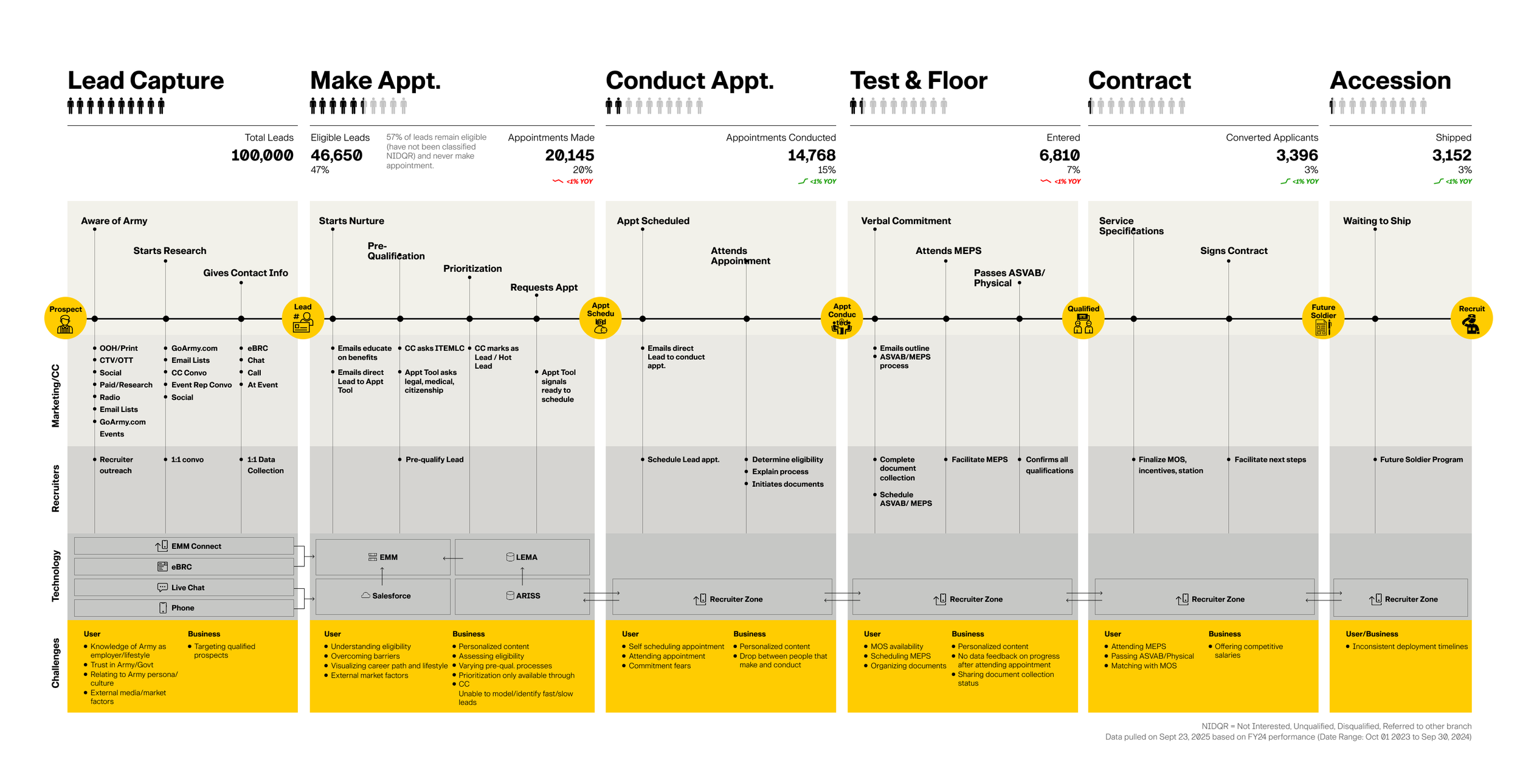
The completed artifact visualized every recruiting stage from awareness through accession, connecting customer goals, business processes, technologies, pain points, and opportunities into a single source of truth.
Outcome
The journey map quickly became much more than a research artifact.
It was adopted as:
onboarding material for new team members
a strategic planning resource
a reference for campaign development
a foundation for future UX initiatives
It continues to influence how recruiting experiences are understood across the account.
Business Impact
Although this project was research-focused, it created significant organizational value.
🏛️ First documented end-to-end recruiting journey
🤝 Improved cross-functional alignment
📈 Identified lifecycle marketing opportunities
🧭 Informed future UX strategy
📚 Became onboarding material for new team members
